For this project, my team member Jacob Coleman and I wanted to look at a possible solution to fix the issue of extreme travel within college football conferences. To contextualize the problem it is best to look at the University of Oregon’s membership in the Big 10 conference. Each year, they have to fly nearly all the way across the country to play conference opponents like Penn State and Ohio State. After looking at this, we decided that we wanted to minimize the total distance between teams within their respective conferences. For this problem our main data source was a large matrix that contained the distance between each FBS team. Topics from Industrial Engineering courses that I found helpful for this project include optimization and data visualization. The role of optimization is pretty clear in this problem as we created a mathematical model to minimize total distance teams travel within their conferences. Data visualization was also very helpful because ended up looking at plots of distances that teams have to travel to get a good idea of what our solution needed to look like.
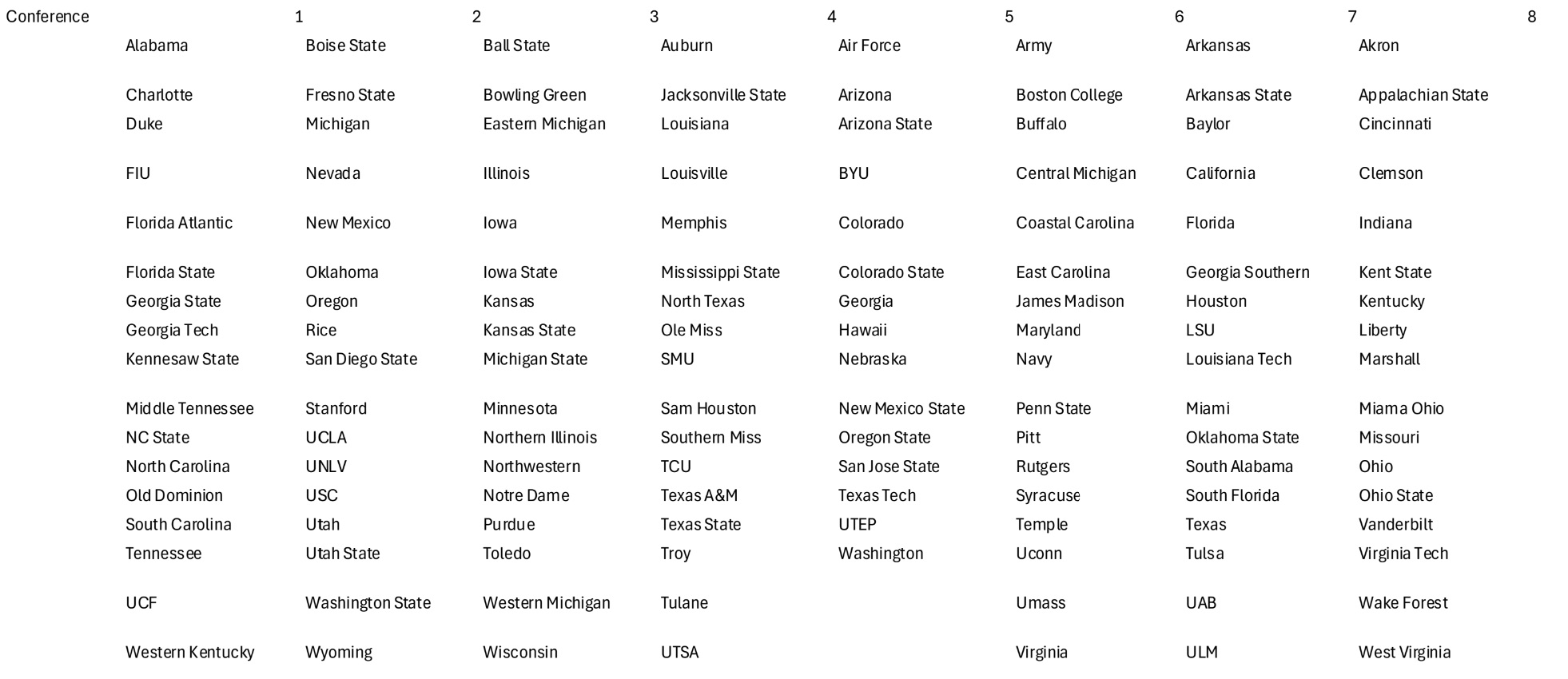
Initially, we wanted to try to realign the conferences based on both distance and program ranking to attempt to create competitive conferences. While implementing our model, we found that there was simply too much data for the solver to handle and we were unable to find an optimal solution. We then pivoted to remove the ranking component of our model and instead just focused on distance. The solver still struggled to handle the data but after running for two hours, we were able get a pretty good solution that fit our expectations for the original project idea. The solution is depicted in the following image:
I am particularly proud of our optimization model because I believe that it does a very good job of representing our problem. This part is probably the most crucial to our entire project because it is how we represent the effect of including a team in a conference mathematically.
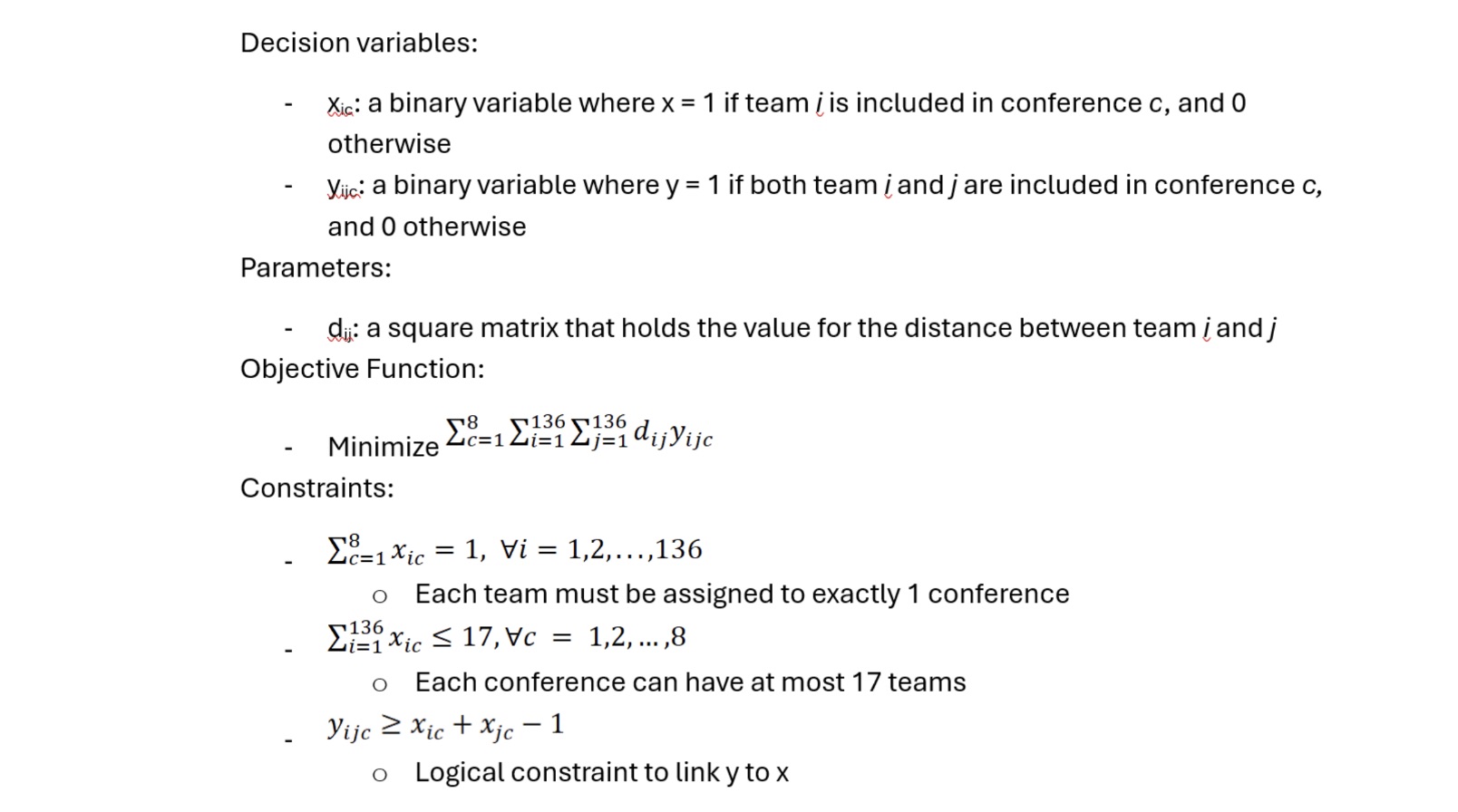
Overall, I enjoyed working on this project. Throughout the process, I learned how to teach myself new skills that would help me implement my ideas into a working model. I am most proud of my contributions to the modeling and implementation portions of the project because I came up with ideas that worked even though I wasn’t fully confident in my abilities. I ended up pulling together the skills we built surrounding basic modeling and binary variables in order to build a working model. After doing this project, I feel more confident in my abilities to brainstorm ways to represent optimization problems mathematically, use binary variables, and implement logical constraints.